
History
Pearl Hart: The Bandit Queen of Yuma
The Last Stagecoach Robbery in the Wild West
Part 1: The Last Stagecoach Robbery
By 1899, the "Wild West" was supposedly tamed. The railroads were everywhere, and the era of the highwayman was dead. But Pearl Hart didn't get the memo.
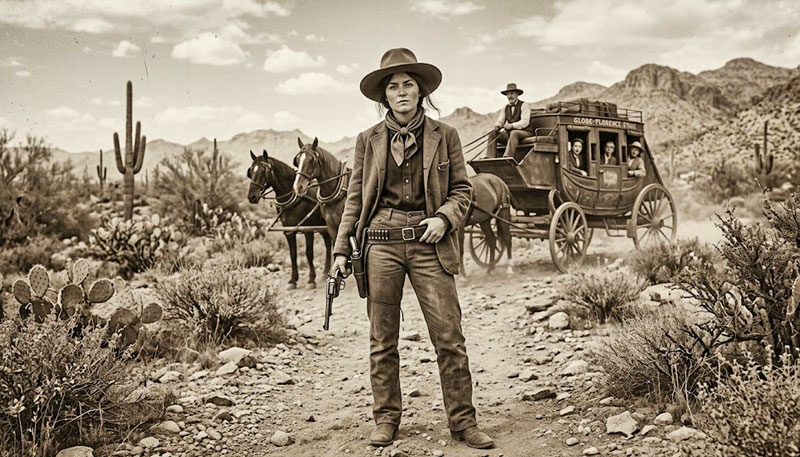
Pearl was a small, five-foot-tall firebrand who had fled a stagnant life in Canada for the chaos of the Arizona mining camps. When she received word that her mother was dying and she had no money for a train ticket, she didn't look for a job—she looked for a gun. Along with a drifter named Joe Boot, she cut her hair short, put on men's clothing, and headed for the watering hole at Kane Springs.
On May 30, 1899, the stagecoach from Globe to Florence slowed down as it hit the steep canyon grade. Suddenly, two figures stepped from the brush. Pearl, despite her size, held a .38 caliber revolver steady on the driver. They robbed the passengers of about $450—a massive sum at the time—but Pearl showed a strange "outlaw's mercy." She handed each passenger $1 back so they could afford a meal when they reached town.
Pearl and Joe weren't professional outlaws. They got lost in the desert almost immediately. Instead of riding for the border, they wandered in circles and fell asleep around a campfire. A few days later, a posse led by Sheriff Truman found them resting. Pearl reportedly didn't go quietly, supposedly saying, "I shall not surrender. I am the daughter of a king!"
She was arrested and taken to the jail in Florence, but the legend was just beginning. The press caught wind of a "female bandit," and within days, Pearl Hart was the most famous woman in the Arizona Territory.
Part 2: The Trial of the Century
When Pearl Hart was locked up in the Florence jail, she didn't act like a prisoner; she acted like a star. She turned her cell into a reception room, granting interviews to reporters from as far away as New York and London.
Pearl knew that in the Victorian West, men had a hard time believing a woman could be a cold-blooded criminal. She played into this perfectly. She showed up to court looking demure and fragile, weeping about her dying mother and her "broken heart."
When she took the stand, she didn't deny the robbery. Instead, she made a bold, political statement that stunned the room:
"I shall not consent to be tried under a law which my sex had no voice in making, passing, or enforcing."
The evidence against her was mountain-high. She had been caught with the money, the gun, and the victims had identified her. But Pearl had the jury in the palm of her hand. After a short deliberation, the jury returned a verdict that made the judge nearly fall off his bench: Not Guilty.
The jury felt that a woman shouldn't be sent to a "Hellhole" like Yuma for trying to help her mother. Judge Fletcher Doan was so outraged by the verdict that he immediately dismissed the jury, calling them a "disgrace to the territory."
The law wasn't finished with her. They immediately arrested her again for "tampering with the U.S. Mail." This time, with a new jury and a much sterner atmosphere, Pearl was convicted and sentenced to five years in the Yuma Territorial Prison.
Part 3: The "Pregnancy" and the Pardon
Pearl Hart's arrival at the Yuma Territorial Prison was a logistical nightmare. As the only woman in a fortress built for 200 of the territory's most violent men, she was a powder keg.
Because there was no women's ward, the guards built Pearl a private, oversized cell. It was relatively "luxurious" compared to the stone ovens of the main block. She spent her days writing poetry and letters to the press, maintaining her status as a celebrity.
Then, in 1902, the prison was rocked by a scandal: Pearl Hart was pregnant.
This presented an impossible problem for Governor Alexander Brodie. If a woman became pregnant while serving time in a maximum-security prison under the "total control" of the state, it implied one of two things: either the guards were complicit, or the prison was fundamentally broken.
The scandal was a ticking time bomb. The last thing the Arizona Territory needed while fighting for statehood was a headline about a "Bandit Queen" giving birth in a dungeon.
In a move that many historians believe was a desperate "hush-hush" arrangement, Governor Brodie issued Pearl a pardon on December 19, 1902. The official reason? To allow her to return to her family and care for her "ailing mother."
The real reason? Pearl was a PR disaster that the Governor wanted gone immediately. She was released after serving only two years of her five-year sentence.
What happened next is one of the great mysteries of the Old West. There is no official record of Pearl ever giving birth to a child after her release, leading some to wonder if she had faked the pregnancy—perhaps using padding or a clever ruse—to force the Governor's hand.
Today, Pearl Hart's cell remains one of the most popular stops at the Yuma Territorial Prison State Park. She remains the ultimate symbol of the "Wild" in the West—a woman who refused to be caged by the law or the expectations of her time.
Keep reading
Follow the next thread.
 History
Secrets Beneath the Sand
The complete story of Yuma, from the river crossing to the winter salad bowl.
Read the story History
The Dark Cell
America's most haunted room. Cold spots, scorched handprints, and a whisper that says Stay.
Read the story History
The Gates Riot of 1887
Seven desperate inmates attacked the superintendent. The prison nearly broke open.
Read the story